Thursday, 6 October 2011

DSDN 171 Assignment 10


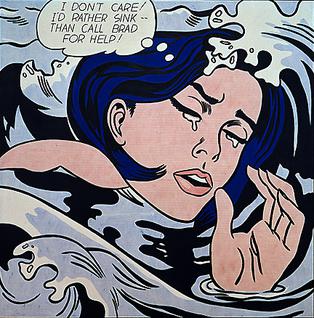
fig.1

This is an image that is an example of pop art from the 1960's and 1970's by Roy Lichtenstein.  This is also an example of manipulation of scale.  The image is a frame from a comic book that has been enlarged and put on canvas and displayed in a gallery.  Much of Lichtensteins work was very similar.  The aim of this work was to bring what used to be considered the high and low cultures and bring them together to form a unified culture.  By taking a small frame from a comic, a medium considered to be a part of low culture, and enlarging it and putting it on canvas and displaying in a gallery, where high culture is normally displayed, he attempted to show that the work that goes into a single comic frame, though considered insignificant by the  higher cultured is in fact on par with that of the high culture.  This aimed to show that their beliefs in high and low culture was unfounded and that the world only had one level of true culture to which everyone belonged.

References
fig.1      Roy L.(1963) "Drowning Girl" Retrieved October 7 2011, from http://en.wikipedia.org/wiki/File:Roy_Lichtenstein_Drowning_Girl.jpg

Thursday, 29 September 2011

DSDN 171 assignment 9

My belief is that the ideological message behind most design today seems to be very orientated towards the catering to many but making individual.  What this means is designing objects that while mass produced and basically the same, can be modified to almost get the exact experience that the user wants.  The message seems to be that while everyone is different, we all basically want the same thing.


Vid.1

This idea is used as a selling point in many products especially technological devices such as phones and laptops.  The above example of this is the iPhone.  This advertisement from earlier this year uses the world "you" a lot.  This is a way of selling to the audience a design which while designed for everyone, is specifically for you.  This is the same with most mobile devices these days, almost every advertisement  for these product uses the word "you" at least three times.  The reason for this is people are more likely to go and by this product for themselves rather than just having one for the family because it is for the individual, so the company makes more money.  When you think about it still supports the mind set between the 50's and 70's of consumerism, as seen in Pavitt's text[2], but on a larger scale.  Instead of selling just to the lady of the house hold who does the shopping, they are selling to everyone and getting a larger consumer base because of this.

Reference.
Vid. 1   ??(2011, March 26). Apple Pub : iPhone 4 TV Ad Retina Display (VO - Mars. 2011 - HD)[video file]. Retrieved from http://www.youtube.com/watch?v=ruJFBf83k9g


[2]          Pavitt, J. (2008). Design and the Deomocratic Ideal, Cold War Modern: Design 1945-1970 (pp. 72-91) London: V&A Publishing.

Thursday, 22 September 2011

DSDN 171 Assignment 8

I agree with Hannes Mayer's argument that design is a product of science driven by new technology and the potential to mass produce the design.  It is because of this view point that we have most of things we do today. For example, if designers had not used the technology of computers and designed them in such a way that they could be produced for the masses at a good price, the world would be a very different place.  Although I agree with this the is one thing that I believe that Mayer missed and that was the influence of art.
Fig 1


I believe that design to today is a combination of both art and science.  Science is very important as it tells designers how to make an object with a function that works.  For example, the above picture is of Microsoft DOS(Disc Operating System)  While it had the same functionality of more visual operating systems these days, it was not immediately obvious where to go if you wanted something, as you had to call commands to find things.  This is where the art comes in.  Artist know how to convey a narrative to an observer so applying this to the design of an operating system they were able to make it so that the operating systems became more intuitive and needed less prior knowledge to use.

For science to do something for the masses it needs art to interpret it so that they can understand what science has done, in turn art needs science to give it a reason greater than just making beautiful things.  Design in the combination of this, so that the discoveries of humanity can be put to use by the greater population.

References


Benjamin, W. (1992). The Work of Art in the Age of Mechanical Reproduction (pp. 211-244 ) in Illuminations, trans. Harry Zohn. London: Fontana.


Fig 1: Edward H.(2002) "MS-DOS Prompt MemoryCheck" Retrieved September 23, 2011, from http://www.subsowespac.org/sh_xp/silent_hunterxp.shtml

Thursday, 15 September 2011

DSDN 171 Assignment 7


I believe that a "symbolic universe" for this era  would be the one based on a structure of communication.  In a world where communities/families can be separated by thousands of miles, something that is happening more often as people have to look elsewhere for jobs, communication is becoming of bigger importance as people want to keep in touch.

One instance of this is social media websites such as Facebook and Twitter.  People use these to keep in contact with people who they cannot see in person often, such as friends and family overseas.  People also use it to try and contact people who they would normally not be able to contact, such as celebrities.  They also play games with each other over vast distances.  The communications of today allow the world to be almost one community.

The media and designers are helping the world become this one community by designing faster and cheaper communications that become more accessible and easy to use allowing more people to keep in contact with the ones they know and also meet new people of similar likes.

Thursday, 8 September 2011

DSDN 171 Assignment 6

I agree with Benjamin's argument that asking for the authentic print of a print of a photo is pointless.  This is because there is no one authentic print as many copies have been made and they should be all of around the same quality and all portray the same style of the photographer due to them being copies.  It may be worth asking for the original negatives, but even then until they are processed into prints there is very little  aesthetic worth in the negatives, unlike an original painting which has the style of the artist only in the original.

In this era of digital design and manufacture I also believe there is no role of authenticity in the products.  This is because even when the authentic digital copy of a program or a song is even moved from one folder to another the file is copied to the location.  This means that the authentic copy can not be moved around with out technically becoming non-authentic.  The only thing that could be asked for that could be considered original is the first disc made of the software or print of the image but even then it would basically be the same thing if you bought the second or the third so there is very little point.

Authenticity does not have a role in todays digital media due to every copy being the same as the first and still conveying the exact same ideas that the creator had when the made the "original" copy.

Reference


Benjamin, W. (1992) The Work of Art in the Age of Mechanical Reproduction (pp. 211-244 ) in Illuminations, trans. Harry Zohn. London: Fontana.

Thursday, 11 August 2011

DSDN 171 Assignment 5


Without the experimentation of artist and scientist through out the last 300 years our understanding of how colour-vision works would not be at the stage it is at today.  It started with Isaac Newton who studied how the colour actually reaches the eye, but did not study how people subjectively see colour. Artist then began to study subjective colour observations in order to get a greater understanding of how it was perceived.  Goethe studied the how an after image and other subject observations were perceived and worked in his 1400 page paper Farbenlehre.  His study then lead two painters to expand on his work, Phillip Otto Runge and J.W.M. Turner, who expanded on Goethe's work by adding light and shade as a component of colour and giving colours symbolic meanings.  Ogden Rood, in the early 1900's released a book which became a handbook for artists which took the ideas of the previous perception of colour and put it in a way which was easy to read.  He also stated that colour does not need to mixed on a palette but just by putting two colours next to each other on a canvas the eye would mix them together.  The artist from then on started painting more emotive paintings rather than those based off narrative and so colour was used more to get an idea across rather than an accurate representation of the subjects of the painting.

Reference

Gage, J. (1993). Colours of the Mind in Colour and Culture: Practice and Meaning from Antiquity to Abstraction (pp.191-212). New York: Thames and Hudson.

Thursday, 4 August 2011

DSDN 171 Assignment 4

Figure 1 Arad, Ron (2008) Voido, retreived from http://furniture.architecture.sk/

I believe that Adolf Loos argument that "the evolution of culture is synonymous with the removal of ornament from objects of daily use" is untrue.  His belief is that the more cultured and civilized a race was the less ornament they should use, as ornament was the product of criminals and degenerates.  He says this as he believes that ornament adds work to the making of an object and that by doing this a man earns less money making the same object and that this is criminal to the person who makes the object.  But in removing the ornament from the object it can also make it less desirable, and to counter this the form of an object has become more important than the ornamentation when it comes to aesthetics.  So people spend more money on materials that get a nicer finish, such as shinier metals, and more time working on them to get this finish, and when the object is finished it is in itself an ornament.  An example above shows this as while it is a chair and works well as one, it looks like a piece of art as well.  While it is true the ornament has been removed off the object, the object itself is presented so that it takes the place of the ornament and still does its function, which is why I believe Loos' argument to be false.

References
Loos, Adolf (c. 1910) Ornament and Crime
London: Arts Council of Great Britain (1985), 100-103